
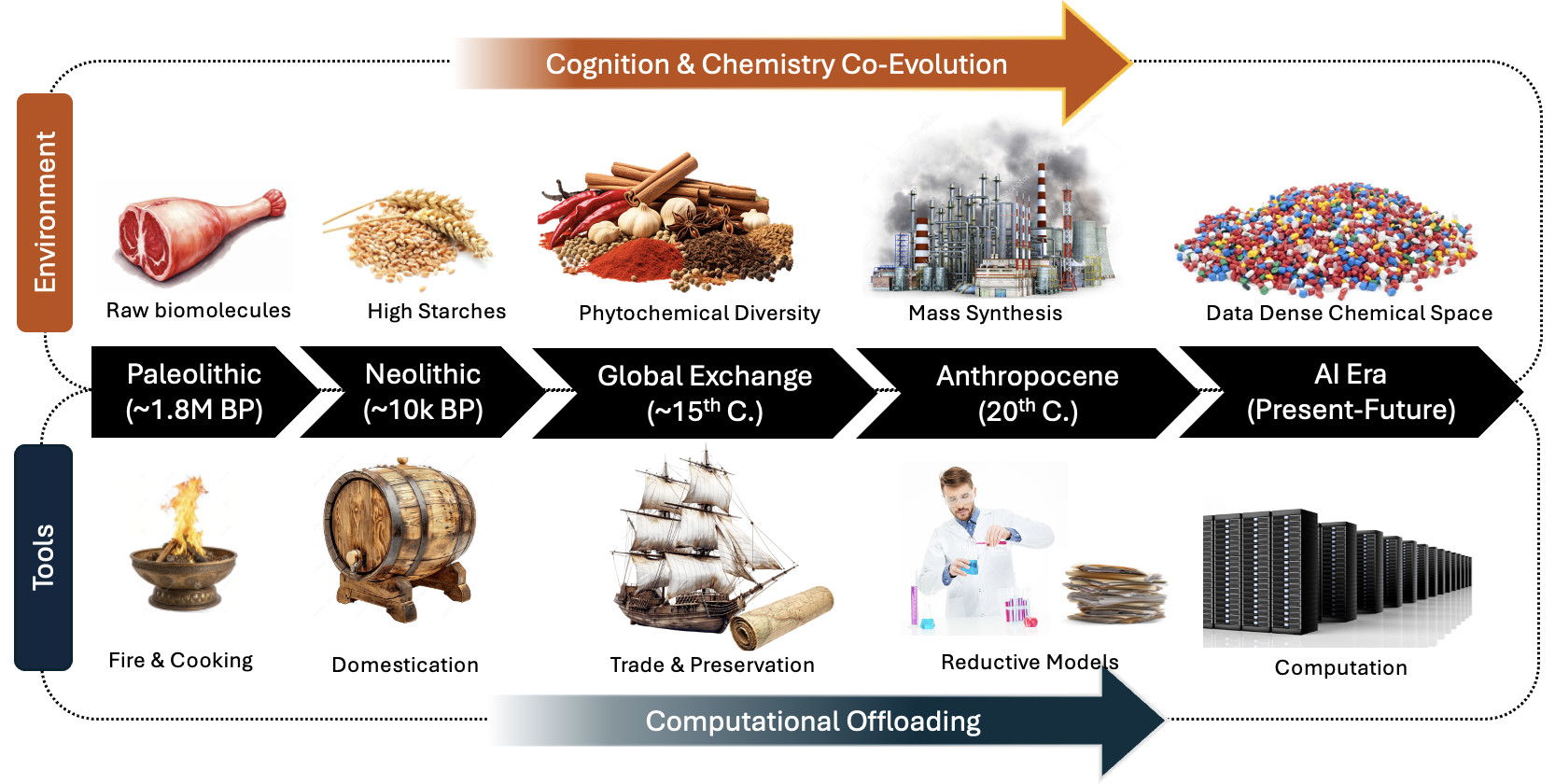
The Earth is unique in the solar system not merely because of its position in the "Goldilocks Zone", but because it exists in a state of extreme chemical disequilibrium. While planets like Mars and Venus are in thermodynamic equilibrium (their atmospheres are chemically "dead" and predictable), Earth's atmosphere is a volatile, high-energy mixture maintained by biological activity.
Before biological life, the planet underwent "chemical evolution", in which mineral catalysts and thermal gradients (like those in hydrothermal vents), facilitated the synthesis of increasingly complex polymers, eventually leading to the first metabolic cycles. Every organism lives in a "chemical niche", and its survival depends on maintaining homeostasis in the face of a fluctuating environment. But life just doesn't react to chemicals; it moves them around like a global "chemical pump" creating the biosphere. The human species occupies a special place in this large chemical dynamical system.
The Chemical Story of Human Evolution
The staggering difference between Homo sapiens and our closest relatives is often attributed to an increase in brain size. However, the drivers of this enlargement have been mostly explained by changes in our social skills and problem-solving.
As we will see, human survival is driven by a feedback loop between chemistry and cognition: the evolution of our ability to solve chemical problems creates new opportunities for cognitive growth, which in turn drives further innovation in chemical processing! In this framework, problem-solving goes beyond biological boundaries to include both chemical and cognitive dimensions. Just as we externalize our cognitive load, we also iteratively delegate chemical processing to the world around us. The core idea of "extended cognition" stems from this offloading of cognition; we emphasize the same mechanism for chemical processing as well.
Fire and Cooking: Externalizing Metabolism
The chemical story of humans starts with fire and cooking. The mastery of fire around 1.8 million years ago and cooking offloaded chemical processing from within the human body, making it possible to break down complex proteins and gelatinize starches, which served as the first stage of chemical digestion outside the body. Chemical processing offloading is analogous to, and a predecessor of, cognitive offloading, which helped the human species solve much harder tasks.
Besides, this form of external processing removed many of the toxins (cyanogenic glycosides, lectins) that could be easily removed by heat. By chemically neutralizing these through cooking, humans reduced the toxicological load on the Cytochrome P450 enzyme system, allowing metabolic energy to be redirected toward neural development.
The Expansive Tissue Hypothesis suggests that the enlargement of the human brain was impossible without a radical reconfiguration of the body's chemical processing units. Even though the human brain accounts for only 2% of the body's weight, it consumes 20-25% of the body's total basal metabolic rate (BMR). This is in stark contrast to other species, where most of their energy is devoted to gastrointestinal processing of food. The shrinking of human gut size was due to the availability of high-quality, nutrient-dense foods made possible by cooking.
By increasing the energy density and reducing the toxicological load, the metabolic energy was redirected to the brain, making it easier for humans to allocate time to solving more complex cognitive problems in their environment, which sets the conditions for the next evolutionary cycle.
The Neolithic Transition: A Bio-Chemical Turning Point
The transition from a Paleolithic hunter-gatherer lifestyle to a sedentary, agricultural society, beginning roughly 10,000–12,000 years ago, became possible due to larger brains that could plan, memorize, and solve much more complex problems. This shift triggered a profound change in the trajectory of human evolution. This "Neolithic Transition" introduced novel selective pressures arising from three primary sources: zoonotic exposure, dietary shifts, and an expanded xenobiotic landscape.
The shift to an agricultural high-starch diet forced fast metabolic evolution. In response to this change, the human genome underwent positive selection for the AMY1 gene, which encodes salivary amylase, enabling more efficient carbohydrate breakdown. On the other hand, the consumption of non-human dairy led to the evolution of lactase persistence. Agriculture also exposed us to a range of toxins, including alkaloids and cyanogenic glycosides found in domesticated crops. This challenged our enzymatic arsenal, specifically the Cytochrome P450 (CYP) superfamily. These enzymes evolved to oxidize and neutralize these new chemical threats. Interestingly, variation in modern human drug metabolism is often a direct legacy of these ancient adaptations to local agricultural flora.
This should also be understood in the context of a similar chemical challenge posed by cohabitation with domesticated animals, which introduced humans to a "pathogen pool" previously unknown to our species. New diseases, including influenza, smallpox, and tuberculosis, originated as zoonoses from cattle, pigs, and poultry. They restructured our MHC that still lives with us.
On the other hand, humans solved part of this chemical challenge by externalizing it, managing the xenobiotic landscape through crop and animal selection and preparation. The cognitive abilities of the human species, as a result, expanded even larger.
Global Chemical Exchange
The mastery of agriculture and pastoralism was the precursor to the first civilizations, as human cognitive capability expanded to support a larger population and better control of the environment over the last couple of millennia.
The transition from localized agriculture to globalized trade, catalyzed by the Age of Discovery and the Columbian Exchange, represented a massive expansion of the human exposome. This period "globalized" the human biochemical landscape, introducing a vast array of chemicals that had never been encountered by specific regional populations.
The exchange of spices might be one of the biggest factors: spices are plant secondary metabolites to defend against pathogens. The global exploration of compounds like capsaicin from the Americas and piperine from Asia brought them to the rest of the world, changing our chemical machinery in multiple ways. For example, these chemicals interact with TRPV1 receptors and are processed by a complex network of detoxification enzymes, primarily in the liver. This forced human populations to adapt to new levels of phytochemical diversity, many of which had antimicrobial properties that aided food preservation and gut health in new, warmer climates.
These new chemicals also externalized many of our defenses against pathogens and metabolites by using spices as external antimicrobial agents to preserve food. As a result, the human population increased even more! This enhanced gut health and food stability across diverse climates, supporting further global expansion.
The Chemical Anthropocene and the Great Acceleration
The 20th century marked a shift from Biotic Exchange to what we call today the Great Acceleration, a period that is characterized by our accelerated impact on life and the Earth. For the first time, human biology was not just adapting to new "natural" chemicals (phytochemicals), but to a massive influx of man-made xenobiotics. The advancement of industrial organic chemistry enabled the synthesis of molecules with structural motifs entirely absent from biological evolution over the past 4 billion years.
Prior to the 1900s, humans primarily encountered chemicals produced by biosynthesis, but we later invented new ways to explore the chemical space. Some of these chemicals were designed to be stable and resistant, creating some of the biggest disasters in human history. The production of Persistent Organic Pollutants (POPs), such as DDT and PCBs, was engineered for durability. On top of that, these chemicals are mostly lipophilic, leading to accumulation in apex predators, including humans.
| Stage | Cognitive Tool | Chemical Offload |
|---|---|---|
| Early Human | Fire & Tools | External digestion |
| Agricultural | Domestication | Selective toxicity |
| Globalized | Trade Networks | Phytochemical diversity |
| Anthropocene | Industrial Chemistry | Synthetic scaffolds |
| AI Era | Artificial Intelligence | Molecular simulation |
Table 1: Evolution of Cognitive Offloading and Chemical Processing
Unprecedented Chemical Pressure
The human body has never been under such great pressure from the exposome we have created with synthetic chemistry. We can identify at least three main categories of these chemicals, from the most hazardous to the least. On one side of the spectrum lie the very toxic industrial chemicals. These are the chemicals commonly used in manufacturing, agriculture, and machinery. Then we have failed drugs that are used in humans or animals because of toxicity issues. Then we have drugs that are "approved" but have side effects, and finally "safe" chemicals used in food on a larger scale.
Exposure to more than 80,000 industrial chemicals can cause problems in two main ways:
- Functionalization: The CYP enzyme superfamily evolved to handle natural toxins, but facing this vast diversity can lead to metabolic interference and cell death.
- Bioactivation: In some cases, our enzymes mistakenly convert a relatively harmless synthetic chemical into a highly reactive electrophile or free radical, which can then damage DNA or trigger cellular stress, a process known as metabolic bioactivation.
Many of these synthetic chemicals, known as Endocrine Disrupting Chemicals (EDCs), can bind to natural hormones and hijack biological signaling pathways, leading to developmental, reproductive, and metabolic disorders.
Moving to less toxic chemicals stands the drug industry: it creates compounds designed for high potency and specific receptor targeting. However, because these molecules often feature novel chemical scaffolds never seen in nature, they pose a unique challenge to our enzymatic machinery. These can create at least two main challenges:
- The Risk of Bioactivation: While metabolism (via Cytochrome P450) usually detoxifies substances, about 7% of metabolites from commercial drugs are actually more toxic than the parent compound. These are often reactive electrophiles that form covalent bonds with DNA, potentially leading to idiosyncratic drug-induced liver injury (DILI).
- Saturation and Polypharmacy: Modern humans often exist in a state of "Polypharmacy", taking multiple synthetic drugs simultaneously. This can lead to competitive inhibition, in which one drug blocks the enzyme needed to clear the other, causing the second drug to reach toxic levels in the blood.
Finally, the food that we consume is poorly understood. Traditional nutrition focuses on roughly 150–180 well-characterized components: calories, proteins, fats, and vitamins. However, mass spectrometry and modern "foodomics" have revealed a staggering reality: the vast majority of what we ingest is "Nutritional Dark Matter". Research through databases like FooDB has identified over 70,000 unique chemical compounds in our food supply. A single cherry tomato contains nearly 4,000 compounds, most of which are unmapped and untracked by public health agencies.
On the other hand, the primary vehicle for new chemicals is the Ultra-Processed Food (UPF). UPFs contain chemicals that are active agents of cellular disruption. For example, non-caloric artificial sweeteners (sucralose, aspartame) can saturate the liver's detoxification pathways, causing "metabolic traffic jams" that interfere with the way our bodies process natural sugars and lipids, leading to Metabolically Dysregulated-Associated Steatotic Liver Disease (MASLD). Recent studies describe UPFs as vehicles that deliver biologically active xenobiotics directly into the bloodstream.
Next Evolutionary Step: Computational Chemical Offload
As established at the beginning, a central motif defines our evolutionary history: a continuous feedback loop between chemical and cognitive problem-solving. This interaction has historically allowed us to survive within an ever-shifting chemical space. Now, in this new century, we must first identify our current position within this evolutionary cycle.
It is difficult to overstate the magnitude of the changes we have imposed upon our environment. Consequently, the burden of selective pressure now rests heavily on our biological systems. The high cost of our bodies' slow chemical adaptation leaves us with a singular choice: we must use our cognition to rescue our chemistry. For the last century, we have relied primarily on intuition and reductive models to understand how our bodies interact with an expanding chemical universe. The limitations of this approach have led to systemic failures in our environment, pharmaceuticals, and food industries, consequences that continue to haunt us today.
The core of the problem lies in the sheer complexity and scale of chemical space. These interactions far exceed the innate cognitive limits of the human brain. To move forward, we must follow the pattern of our ancestors and externalize our cognition. The advent of modern computing and the rapid evolution of Artificial Intelligence mark the most significant technological revolution of our era. The ability of these models to generalize and reason through complex problems has ushered in a new age of innovation. Yet, until now, their application has remained largely siloed in specific, non-biological domains.
"We are witnessing a powerful convergence of data density and predictive power. Decades of digital record-keeping regarding chemical interactions and human biomedical health data have created a massive, untapped reservoir of knowledge."
We are now witnessing a powerful convergence:
- Data Density: Decades of digital record-keeping regarding chemical interactions and human biomedical health data have created a massive, untapped reservoir of knowledge.
- Predictive Power: Our models of chemistry, from quantum mechanics to complex protein structures, have reached a breaking point. What once seemed like insurmountable barriers are falling; we can now simulate real-world molecular properties with impressive accuracy, often without the need for physical experimentation.
This convergence presents a historic opportunity, one that is not only economically significant but vital to our survival as a species. It is time to take the next necessary step in our evolution.
At Absentia, we are developing the models critical to this transition. Our work is not merely a matter of public health; it is a fundamental requirement for the stability of our planet and the future of our global civilization.